Accessibility Accessibility icon
CONSULTATION (303) 951-5829
Accent Image
Achieving Balance: Correcting Breast Asymmetry

Achieving Balance: Correcting Breast Asymmetry

March 21, 2014

logo

If your breasts are different sizes, you’re not unusual and you’re not alone. Approximately 88 out of 100 women have one breast that is slightly larger than the other; this is called breast asymmetry. For many women, it’s so slight that you can hardly tell. For others, especially when the difference is as much as one full bra size, the effects can be distressing, leading to embarrassment and low self-esteem.

If you feel this way, or want to explore options for correcting breast asymmetry,  Dr. Buford can help. As a nationally recognized expert in the field of primary and secondary breast surgery, Dr. Buford can skillfully assess the differences in the size and shape of your breasts, review your options and present the procedures to help you. Imagine the joy of a bra that really fits! No more bra inserts! It is possible.

Here are 3 potential solutions:

Fill in the Smaller Breast

You can get implants. This means breast augmentation, a procedure that Dr. Buford has perfected through extensive training and education. It is a very reasonable way to balance your breasts. It’s one of the most common procedures performed in the United States and can result in larger, firmer, more even breasts. The enlargement is usually done with implants made of either saline or silicone gel.

Reduce the Larger Breast

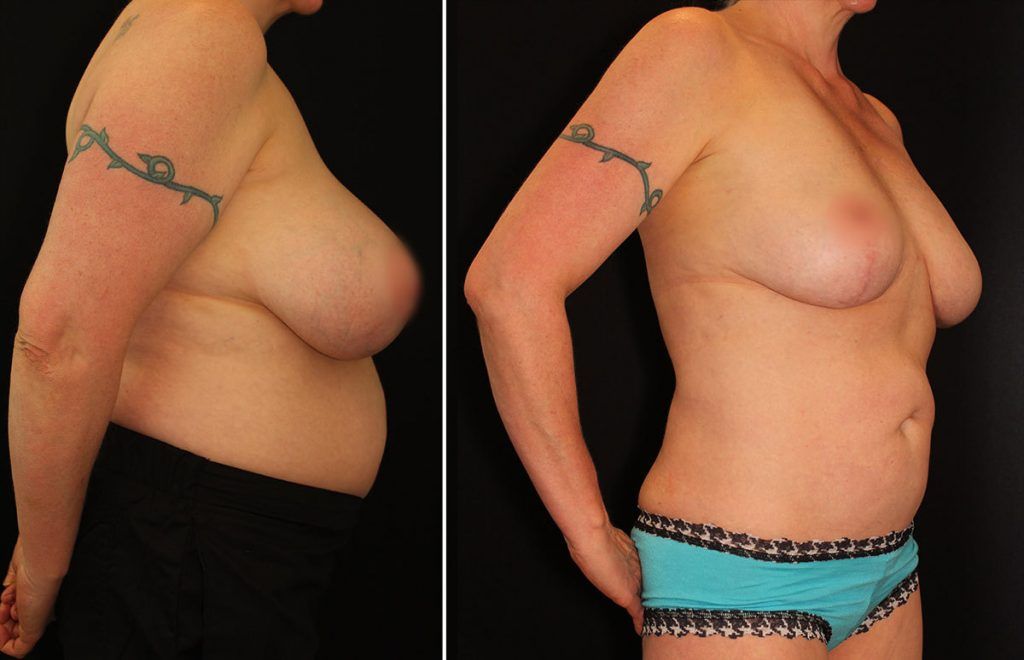
You can get a breast reduction. This surgery is another option for balancing out uneven breasts. If your breasts are large and you are unhappy with their size, this option may be the ideal choice. The procedure removes excess tissue from the larger breast to even out symmetry. The skin is then tightened to complete the process and enhance your overall appearance.

Dr. Buford offers VASER Assisted Breast Reduction, a revolutionary new technique to achieve smaller, perkier, balanced breasts. This procedure allows Dr. Buford’s patients to heal faster than with traditional breast reduction surgeries. The technique uses liposuction to remove fatty deposits that weigh breasts down, which allows the breast tissue to shrink, lift and reduce volume. This procedure is best suited for younger patients with good skin elasticity.

Lift Them Into Place

You can get a breast lift. For many women, asymmetry is accentuated as they age and their breasts begin to droop. This makes breast lift an ideal choice for patients who want more youthful-looking breasts, in addition to improved symmetry. A breast lift removes extra skin surrounding your breasts and tightens the remaining skin. The procedure also repositions the nipples, to restore them to a youthful level and improve symmetry.  Dr. Buford uses an “invisible bra” technique to provide superior perkiness, as compared with a typical breast lift.

You can also combine procedures to achieve balance and obtain your cosmetic goals. For example, a lift and an augmentation can be performed together to reshape and reposition your breasts in a flattering, natural way.

When considering your many options, it is important to get advice from a qualified Plastic Surgeon like Dr. Buford, who specializes in this area and has performed over 3000 breast procedures. Be sure to confirm that any Plastic Surgeon you consult with is also certified by the American Board of Plastic Surgery.

Your goals for achieving balanced breasts are personal, so it will also be important that you develop a good rapport with your doctor, and feel comfortable talking with them. There are many variables to consider and your Plastic Surgeon will help guide you toward the right approach. Dr. Buford would be happy to discuss your options during a consultation.

Visualize your NEW LOOK in 3D NOW

START NOW
Natrelle® Breast Implants
IMPORTANT SAFETY INFORMATION

Breast implants are not lifetime devices. The longer patients have them, the greater the chance they will develop complications, which may require more surgery. Breast implants have been associated with a cancer of the immune system called breast implant–associated anaplastic large cell lymphoma (BIA-ALCL). Some patients have died from BIA-ALCL. Patients have also reported a variety of systemic symptoms such as joint pain, muscle aches, confusion, chronic fatigue, autoimmune diseases, and others.

Natrelle® Breast Implants are for breast augmentation and revision surgery in women at least 22 years old for silicone-filled implants and women at least 18 years old for saline-filled implants.

You should not get breast implants if you currently have an active infection, untreated breast cancer or precancer, or are pregnant or nursing. Tell your doctor about any conditions you have, any medications you are taking, and any planned cancer treatments. Breast implantation is likely not a one-time surgery.

Having implants removed and not replaced may lead to permanent cosmetic changes of the breasts. Breast implants may affect breastfeeding. Gel implants may rupture without symptoms, so periodic imaging after surgery is recommended.

Key complications are reoperation, implant removal, implant rupture, implant deflation with saline-filled implants, and severe capsular contracture.

Talk to your doctor for more information.

The use of Natrelle® Breast Implants is restricted to licensed physicians who provide information to patients about the risks and benefits of breast implant surgery.

Visualize your
NEW LOOK in 3D NOW!

Start now
START NOW
Natrelle® Breast Implants
IMPORTANT SAFETY INFORMATION

Breast implants are not lifetime devices. The longer patients have them, the greater the chance they will develop complications, which may require more surgery. Breast implants have been associated with a cancer of the immune system called breast implant–associated anaplastic large cell lymphoma (BIA-ALCL). Some patients have died from BIA-ALCL. Patients have also reported a variety of systemic symptoms such as joint pain, muscle aches, confusion, chronic fatigue, autoimmune diseases, and others.

Breast implants are not lifetime devices. The longer patients have them, the greater the chance they will develop complications, which may require more surgery. Breast implants have been associated with a cancer of the immune system called breast implant–associated anaplastic large cell lymphoma (BIA-ALCL). Some patients have died from BIA-ALCL. Patients have also reported a variety of systemic symptoms such as joint pain, muscle aches, confusion, chronic fatigue, autoimmune diseases, and others.

Breast implants are not lifetime devices. The longer patients have them, the greater the chance they will develop complications, which may require more surgery. Breast implants have been associated with a cancer of the immune system called breast implant–associated anaplastic large cell lymphoma (BIA-ALCL). Some patients have died from BIA-ALCL. Patients have also reported a variety of systemic symptoms such as joint pain, muscle aches, confusion, chronic fatigue, autoimmune diseases, and others.

Breast implants are not lifetime devices. The longer patients have them, the greater the chance they will develop complications, which may require more surgery. Breast implants have been associated with a cancer of the immune system called breast implant–associated anaplastic large cell lymphoma (BIA-ALCL). Some patients have died from BIA-ALCL. Patients have also reported a variety of systemic symptoms such as joint pain, muscle aches, confusion, chronic fatigue, autoimmune diseases, and others.