
Accessibility Accessibility icon
CONSULTATION (303) 951-5829
Accent Image
Is Liposuction Really Necessary with a Tummy Tuck?

Is Liposuction Really Necessary with a Tummy Tuck?

Is Liposuction Really Necessary with a Tummy Tuck?

February 28, 2012

As a Denver Plastic Surgeon, I am routinely asked about combining a Tummy Tuck and Liposuction.  And the number one question is, “Do I really need the liposuction?”  The answer to this question is not the same for everyone and really depends on where you start and what type of result you are looking for.

BEAUTY by BUFORD Image

BEAUTY by BUFORD Image
Does everyone need a combination approach?  No.  To answer this, you really need to look at the three dimensional view of your abdomen and back and circumferentially examine what is going on.  Many people notice fat that has accumulated around their love handles and upper buttocks.  And even if they exercise, this fat often doesn’t go away.  Resistant areas such as this are great targets for liposuction and can great a “WOW” result following a tummy tuck because it simply blends everything better.  By addressing the flanks, the sides, the upper buttocks, and the abdominal wall, I usually create a result that is far better than that accomplished with a tummy tuck alone.  And that is  why a majority of my patients will opt for a combination approach as compared to the tummy tuck alone.

So what does a tummy tuck really do?  By itself, the tummy tuck procedure effectively tightens loose muscle to the middle of the abdomen and removes excess skin.  Alone, it does very little to nothing to address fat.  That is why a majority of Plastic Surgeons have added liposuction to their tummy tuck procedures.  It simply improves the overall result.

But what about that laser procedure you just saw on TV?  You’ve had two kids and you’re not happy with the appearance of your tummy.  And didn’t it promise to flatten your abdomen, and bring those loose muscles together?  Probably.  But as with most cases where it simply sounds too good to be true, this is the same.  As consumers we are continuously bombarded with options and many of these options promise to be better than traditional treatments.  And sometimes they are.  But, unfortunately, many of these new procedures are simply technologies looking for an application.   Simply firming up abdominal skin will not address the muscle separation beneath and can simply not give you the same result as a tummy tuck.

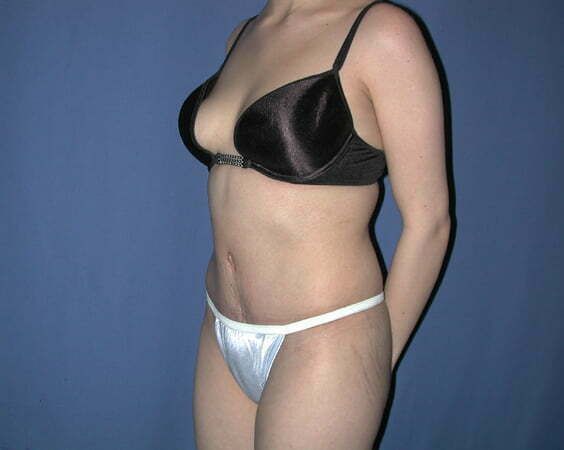
Also, be very wary of before and after photos.  I emphasize to every one of my patients that they need to carefully scrutinize the lighting, the angle, and the overall picture.  Unfortunately, some practitioners will show photos that look amazing but the simple fact is that the procedure yielded less of the result than the photography.  Another important factor to consider is the source of the photos.  I was surprised to read an article this week that suggested some practitioners are using stock photos for their before/after’s and not their own.  Ask your physician whether or not these are actual patient examples.  If the practitioner does not have photos because he hasn’t performed many of these procedures, this is not a red flag but it certainly should be taken into consideration.

I hope that helps!  If you are interested in learning more about the exciting combination procedure of a Tummy Tuck plus Liposuction, I encourage you to contact me at 303.747.6719 and see how great your tummy can really look!

Visualize your NEW LOOK in 3D NOW

START NOW
Natrelle® Breast Implants
IMPORTANT SAFETY INFORMATION

Breast implants are not lifetime devices. The longer patients have them, the greater the chance they will develop complications, which may require more surgery. Breast implants have been associated with a cancer of the immune system called breast implant–associated anaplastic large cell lymphoma (BIA-ALCL). Some patients have died from BIA-ALCL. Patients have also reported a variety of systemic symptoms such as joint pain, muscle aches, confusion, chronic fatigue, autoimmune diseases, and others.

Natrelle® Breast Implants are for breast augmentation and revision surgery in women at least 22 years old for silicone-filled implants and women at least 18 years old for saline-filled implants.

You should not get breast implants if you currently have an active infection, untreated breast cancer or precancer, or are pregnant or nursing. Tell your doctor about any conditions you have, any medications you are taking, and any planned cancer treatments. Breast implantation is likely not a one-time surgery.

Having implants removed and not replaced may lead to permanent cosmetic changes of the breasts. Breast implants may affect breastfeeding. Gel implants may rupture without symptoms, so periodic imaging after surgery is recommended.

Key complications are reoperation, implant removal, implant rupture, implant deflation with saline-filled implants, and severe capsular contracture.

Talk to your doctor for more information.

The use of Natrelle® Breast Implants is restricted to licensed physicians who provide information to patients about the risks and benefits of breast implant surgery.

Visualize your
NEW LOOK in 3D NOW!

Start now
START NOW
Natrelle® Breast Implants
IMPORTANT SAFETY INFORMATION

Breast implants are not lifetime devices. The longer patients have them, the greater the chance they will develop complications, which may require more surgery. Breast implants have been associated with a cancer of the immune system called breast implant–associated anaplastic large cell lymphoma (BIA-ALCL). Some patients have died from BIA-ALCL. Patients have also reported a variety of systemic symptoms such as joint pain, muscle aches, confusion, chronic fatigue, autoimmune diseases, and others.

Breast implants are not lifetime devices. The longer patients have them, the greater the chance they will develop complications, which may require more surgery. Breast implants have been associated with a cancer of the immune system called breast implant–associated anaplastic large cell lymphoma (BIA-ALCL). Some patients have died from BIA-ALCL. Patients have also reported a variety of systemic symptoms such as joint pain, muscle aches, confusion, chronic fatigue, autoimmune diseases, and others.

Breast implants are not lifetime devices. The longer patients have them, the greater the chance they will develop complications, which may require more surgery. Breast implants have been associated with a cancer of the immune system called breast implant–associated anaplastic large cell lymphoma (BIA-ALCL). Some patients have died from BIA-ALCL. Patients have also reported a variety of systemic symptoms such as joint pain, muscle aches, confusion, chronic fatigue, autoimmune diseases, and others.

Breast implants are not lifetime devices. The longer patients have them, the greater the chance they will develop complications, which may require more surgery. Breast implants have been associated with a cancer of the immune system called breast implant–associated anaplastic large cell lymphoma (BIA-ALCL). Some patients have died from BIA-ALCL. Patients have also reported a variety of systemic symptoms such as joint pain, muscle aches, confusion, chronic fatigue, autoimmune diseases, and others.