

September 23, 2013
 We all know that stress can negatively impact our lives but many people don’t understand how this actually happens. One of the main reasons that stress is so bad for us is the fact that it raises the hormone, Cortisol. Under normal circumstances, Cortisol is a necessary evil and helps our bodies adapt to stress. But when this stress is prolonged and becomes chronic, elevated levels of cortisol can become very harmful to our health and actually make us sick.
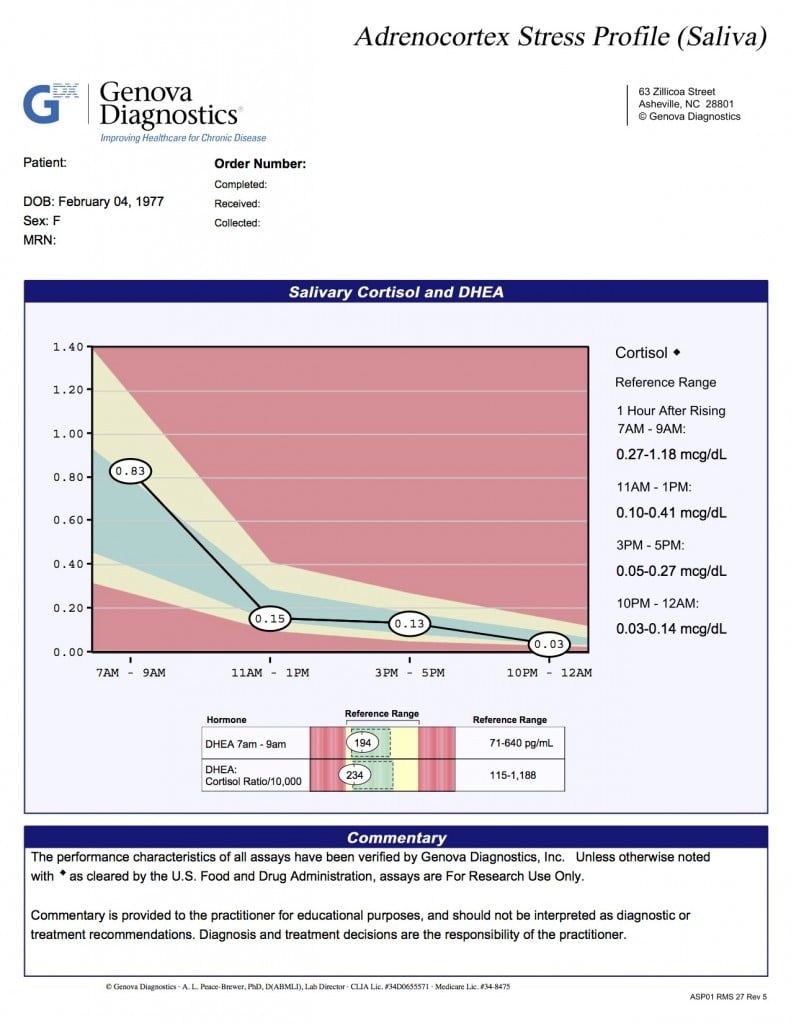
Levels of cortisol fluctuate throughout the day with our highest levels being in the morning hour upon waking. From there, a normal cortisol curve is then tapered and reduced throughout the day with the lowest levels being seen at the end of the day before we go to bed. The curve below illustrates what should happen under fairly ideal conditions and how these levels also correlate with levels of DHEA (dehydroepiandrosterone):
The curve should fall within the green shaded area and should peak in the early morning and then fall to its lowest level at the end of the day. When this curve becomes affected by chronic stress, several things can happen to negatively impact our health.
For example, people under chronic stress often experience low energy levels and find that they have trouble losing weight. One explanation for this is the effect of Cortisol on our thyroid hormones. The thyroid gland produces a pro-hormone called T4 which, under normal conditions, is then converted to the more active hormone T3. However, under chronic stress and high levels of Cortisol, this pathway is re-routed and T4 is converted to “reverse T3”. When this happens, a good percentage of our t4 is processed into the relatively inactive rT3 and we suddenly find ourselves experiencing symptoms of low thyroid even though the thyroid gland itself is actually producing ample amounts of T4. Unfortunately, many conventional labs still do not test for rT3 and so can miss this diversion and we are told that either our thyroid function is normal or that we need more T3 and so we are placed on thyroid replacement. But if stressful conditions continue and Cortisol remains elevated, the increased T4 simply gets shuttled to produce even more rT3 when in reality the problem is not our thyroid but our elevated Cortisol. In this case, the more appropriate treatment is to reduce our stressors and attempt to lower our Cortisol. When this happens, our thyroid achieves balance and the normal pathways resume.
Considering the amount of stress we are all under on a daily basis, the 4-point salivary cortisol test is one of the more common tests that I am ordering for my patients. The point here is to diagnose not only what is going on in the end but, more importantly, what is causing it to happen. In this example, we are treating the cause and not simply addressing a symptom.
I hope this information is helpful and look forward to working with you to achieve more Optimal Health. To contact me directly, please call my office (303.747.6719) or feel free to email me directly (drbuford@beautybybuford.com). Remember, it’s not about quantity of life; it’s about quality of life.
Thanks for taking the time to read this! I look forward to hearing from you.
You Might Also Like