
Accessibility Accessibility icon
CONSULTATION (303) 951-5829
Accent Image

Perlane

in Denver, CO

Smiling woman in a cozy indoor environment.

Perk Up Your Pucker

Sure, sipping a fancy cocktail or coffee out of a straw may seem glamorous, and smiling is something no one should avoid, but life can take its toll on the skin around your lips and nose as you age. Loss of volume, smile lines, and vertical lip lines can leave your lower face looking deflated and aged. Luckily, there’s a solution: Perlane®. A transparent injectable gel made up of hyaluronic acid, Perlane delicately plumps your facial tissue to smooth wrinkles and folds of the lower face.

Face & Skin Self-Assessment

Before you meet with Dr. Buford for your consultation, consider filling out our face and skin self-assessment. By sharing how you see yourself, we can best evaluate your aesthetic goals and determine an appropriate treatment plan for you.

What causes wrinkles around the nose and mouth?

A combination of the natural aging process and lifestyle habits can have a big impact on the quality of the skin in this area. Wrinkle-inducing behaviors include:

  • Smoking. Puckering up and dragging on a cigarette causes your skin to crease around your lips. Over a period of time, those creases stick around even when your lips are at rest.
  • Sipping on a straw. Just like with smoking, the movement of your lips when you drink through a straw contributes to wrinkling of the skin bordering the lips. Play the flute or wind instrument? You may also have a higher risk for lip wrinkles.
  • Smiling. Smile lines play a major role in aging the lower half of your face. Smile lines and nasolabial creases are directly affected by smiling and laughing, though we don’t recommend changing those habits!

While being aware of these habits can help delay the appearance of pesky lines and wrinkles, genetics and age will still impact the appearance of your skin.

Smiling woman with short blonde hair and necklace.
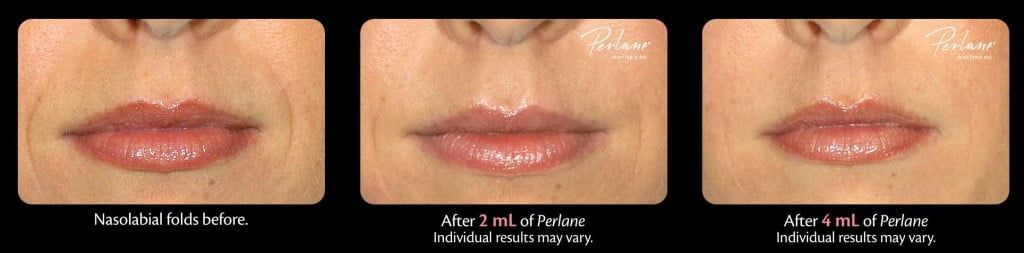
Nasolabial folds treatment before and after photos.

Instantly Beautiful Results

Gregory A. Buford, MD, FACS, PCEO performs all cosmetic injections himself, helping to ensure patient safety and excellent results. As a nationally recognized trainer and consultant for Perlane®, Dr. Buford has an intimate knowledge of how to intentionally and successfully place injections to provide beautiful, natural looking results.

Most patients are happy with their immediate results after just one treatment, but Dr. Buford will work closely with you to determine the best course of action for achieving optimal results. After an injection, you may experience slight swelling, redness, or discomfort that should resolve in under a week. Proven to deliver long-lasting results, Perlane can last up to six months after treatment.

Visualize your NEW LOOK in 3D NOW

START NOW
Natrelle® Breast Implants
IMPORTANT SAFETY INFORMATION

Breast implants are not lifetime devices. The longer patients have them, the greater the chance they will develop complications, which may require more surgery. Breast implants have been associated with a cancer of the immune system called breast implant–associated anaplastic large cell lymphoma (BIA-ALCL). Some patients have died from BIA-ALCL. Patients have also reported a variety of systemic symptoms such as joint pain, muscle aches, confusion, chronic fatigue, autoimmune diseases, and others.

Natrelle® Breast Implants are for breast augmentation and revision surgery in women at least 22 years old for silicone-filled implants and women at least 18 years old for saline-filled implants.

You should not get breast implants if you currently have an active infection, untreated breast cancer or precancer, or are pregnant or nursing. Tell your doctor about any conditions you have, any medications you are taking, and any planned cancer treatments. Breast implantation is likely not a one-time surgery.

Having implants removed and not replaced may lead to permanent cosmetic changes of the breasts. Breast implants may affect breastfeeding. Gel implants may rupture without symptoms, so periodic imaging after surgery is recommended.

Key complications are reoperation, implant removal, implant rupture, implant deflation with saline-filled implants, and severe capsular contracture.

Talk to your doctor for more information.

The use of Natrelle® Breast Implants is restricted to licensed physicians who provide information to patients about the risks and benefits of breast implant surgery.

Visualize your
NEW LOOK in 3D NOW!

Start now
START NOW
Natrelle® Breast Implants
IMPORTANT SAFETY INFORMATION

Breast implants are not lifetime devices. The longer patients have them, the greater the chance they will develop complications, which may require more surgery. Breast implants have been associated with a cancer of the immune system called breast implant–associated anaplastic large cell lymphoma (BIA-ALCL). Some patients have died from BIA-ALCL. Patients have also reported a variety of systemic symptoms such as joint pain, muscle aches, confusion, chronic fatigue, autoimmune diseases, and others.

Breast implants are not lifetime devices. The longer patients have them, the greater the chance they will develop complications, which may require more surgery. Breast implants have been associated with a cancer of the immune system called breast implant–associated anaplastic large cell lymphoma (BIA-ALCL). Some patients have died from BIA-ALCL. Patients have also reported a variety of systemic symptoms such as joint pain, muscle aches, confusion, chronic fatigue, autoimmune diseases, and others.

Breast implants are not lifetime devices. The longer patients have them, the greater the chance they will develop complications, which may require more surgery. Breast implants have been associated with a cancer of the immune system called breast implant–associated anaplastic large cell lymphoma (BIA-ALCL). Some patients have died from BIA-ALCL. Patients have also reported a variety of systemic symptoms such as joint pain, muscle aches, confusion, chronic fatigue, autoimmune diseases, and others.

Breast implants are not lifetime devices. The longer patients have them, the greater the chance they will develop complications, which may require more surgery. Breast implants have been associated with a cancer of the immune system called breast implant–associated anaplastic large cell lymphoma (BIA-ALCL). Some patients have died from BIA-ALCL. Patients have also reported a variety of systemic symptoms such as joint pain, muscle aches, confusion, chronic fatigue, autoimmune diseases, and others.